The digital model is now available on site – BuildEXT at the Proptech Innovation NOW 2024 conference
- May 27, 2024
A building model that can be accessed on site. A contractor who can see where the building services will go through mixed reality. A client looking for the right partners to operate their factory digitally. These were among the examples discussed at the Proptech Innovation NOW 2024 conference to explore what BIM can be used for today.
On May 16, professionals from the real estate, construction and technology sectors gathered at the Budapest Music Center. At Proptech Hungary’s fifth conference, construction digitalisation featured as a dedicated topic, with BuildEXT contributing to discussions on the practical use of models and the role of the digital integrator.
The programme brought together international developments and applications from Hungary. This provided an opportunity to connect discussions about real estate technology to specific workflows. How can a site manager use the model? What information does the operator need? And who makes sure that the same data remains usable in the next stage of the project?
Table of contents
Modell a helyszínen
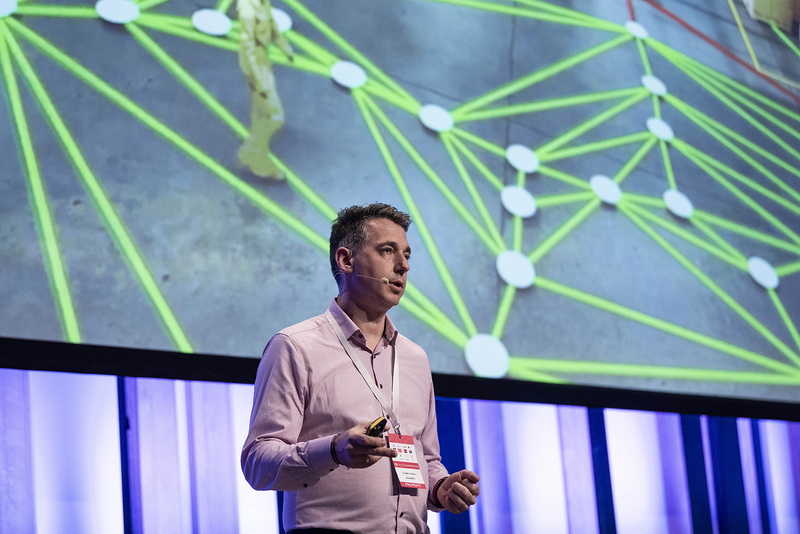
Csaba Livják, founder and CEO of BuildEXT, used Dalux’s augmented reality application to demonstrate how the physical site and the digital model can be brought together. The demonstration included the ground-floor plan of the Budapest Music Center, the proposed interior design and the services routed within the walls.
The value of an application like this is easy to understand if we picture an everyday site coordination meeting. One person is looking at the drawing, another at the wall, while a third is trying to explain how the two will fit together. Overlaying the model on the physical site can help: everyone can discuss the same design, directly in the space concerned.
Of course, this does not automatically resolve every question on site. The visualisation must be backed by an appropriate model and verified information. This is precisely what makes the technology interesting from an engineering perspective: behind the impressive interface lie familiar questions of responsibility. Which version are we looking at? Who updated it? What can we use it for?
One example in the conference report brought this particularly close to construction work: a builder used mixed reality glasses for visual guidance when constructing a challenging wall structure, connecting digital information directly to the task at hand.
Who keeps the building’s data together?
Another prominent topic in BuildEXT’s presentation was the role of the digital integrator. The question sounds simple: if a detailed building model is created during design, why should we not continue using it during construction and operation?
In practice, however, every handover raises new questions. The contractor needs different information from the designer. The operator may also need data that was not yet available when the design was prepared. Meanwhile, the building itself changes: a piece of equipment, a service route or a technical solution may be modified.
The digital integrator’s job is to organise these connections. The model, the project platform, the information requirements and the participants’ work all need to be coordinated. The design model must be updated to reflect changes during construction, and responsibility for further updates must be clarified after handover.
This is also a very practical question for the developer. If they want to modify the building later, what information will they find about it? Can they establish what was actually built? Are the necessary documents available? The value of digital continuity often becomes tangible in precisely these everyday situations.
Case study: Weinberg office building
Csaba Livják also presented the model of the Weinberg office building, which had been handed over in Sárospatak. In the demonstration, the building’s elements were displayed separately by type, making its individual components visible alongside the completed building.
This clearly illustrates why the way a model is structured matters. Beyond the geometry of a wall, window or building services component, its identification and associated data also determine how it can be used later. If these are consistent, the elements can be grouped, extracted and used in further tasks.
The demonstration therefore reflected a working method in which the building and its data are managed together. A model provides a useful basis for collaboration when participants understand what it contains and which state of the building it represents.

Useful BIM starts with the client’s needs
The discussion involving Bosch, LEGO and the University of Pécs also explored experiences from within organisations. Does it help people access information? Does it support decision-making? Can it fit into the organisation’s processes?
At the start of a project, it is worth taking the time to clarify requirements as thoroughly as possible. “We want it in BIM” still leaves many questions unanswered. Discipline coordination, quantity verification and preparation for operation each involve different requirements. When the objective is clear, the necessary model and information requirements are also easier to define.
Alongside selecting the software, people’s work must also be coordinated. Who provides data, when and in what format? Who checks it, and who uses it next? These questions are less spectacular than an on-site AR demonstration, but they are part of the same system.
For BuildEXT, this was the purpose of taking part in the conference: getting the results of digital design into the hands of those who construct, take over and use the building. The tools demonstrated have been available for some time; now we “just” need to establish the data, responsibilities and collaboration required to use them.
You can read about the conference’s other presentations and discussions in Proptech Hungary’s detailed event report.
Follow event organizer Proptech Hungary on Facebook and LinkedIn!

Related content

Does the digitalised company win? Építőipar Summit 2026
Építőipar Summit returns to Budapest on 7 October. Csaba Livják, Founder and CEO of BuildEXT, will take part in a […]
read more
Csaba Livják at Circular Economy Hotspot 2026
On 6 October, he will discuss how digital design and project management tools can support the transition towards circular construction.
read more
Real Estate Beach Conference 2026 – technology is not what is slowing down the construction industry
At the Real Estate Beach Conference 2026 roundtable, Csaba Livják spoke about digitalization, BIM, and more efficient project preparation.
read more