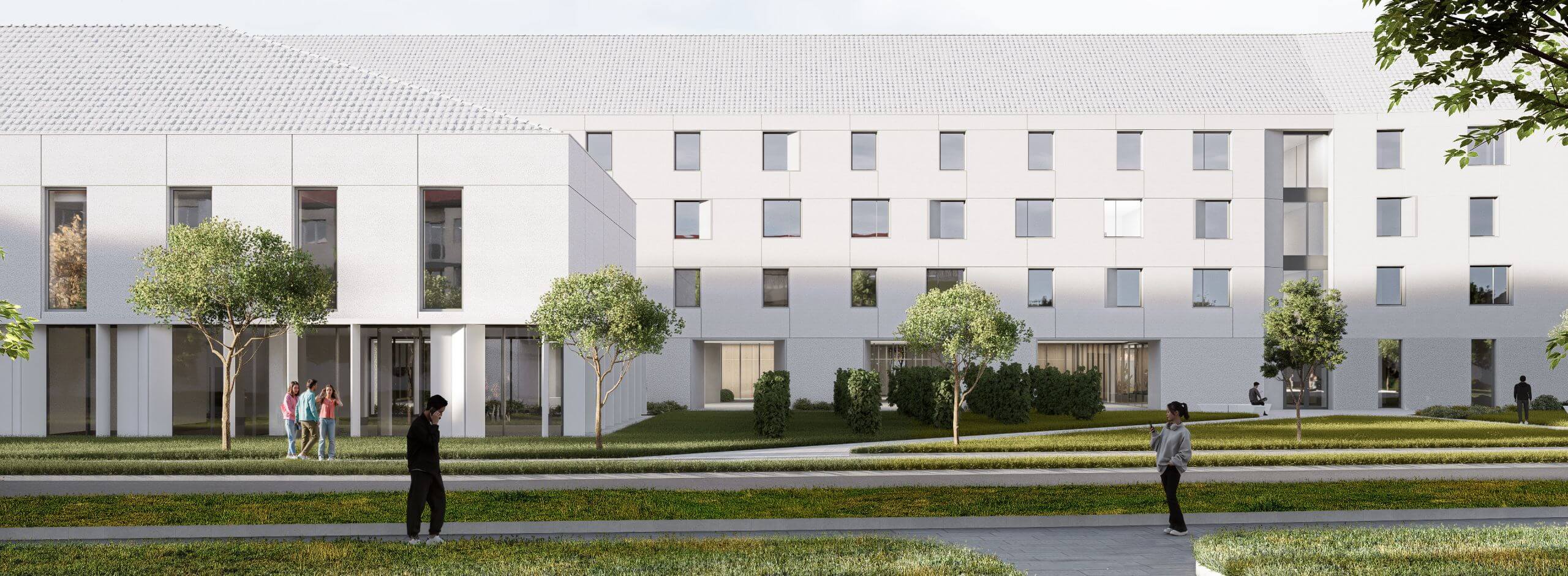
Contemporary campus
in a historic town
THE University Campus in Sárospatak
Client: Tokaj-Hegyalja Egyetemért Alapítvány
Size: 18 900
Location: Sárospatak
Completion: 2027 (planned)
Architect: Csaba Livják, Balázs Csapó
Services: BIM services, General design, Architectural design, Concept design
Sectors: Public, Residential
The project
In April 2025, we were commissioned by the Foundation for Tokaj-Hegyalja University to prepare the concept design for a new university campus and dormitory wing building.
The aim of the expansion-related development was to:
- enable the institution to accommodate the significantly increased student population of recent years by creating new dormitory places,
- provide functions that are partially or entirely missing for the modern operation of the campus, including spaces for sports and recreation, dining, and education.
Constraints and Challenges
The project forms part of the long-term, comprehensive modernisation of both Sárospatak and Tokaj-Hegyalja University. The renovation of the main building was already completed in 2024–25, and the cornerstone of a new municipal teaching pool was also laid last year as part of another project.
In designing the new wing, we had to meet several expectations at once:
- fit into the highly distinctive local architectural traditions of Sárospatak,
- offer an attractive, 21st-century environment for young people that can compete with other university towns,
- take into account the UNESCO World Heritage context, which seeks to protect the landscape of the Tokaj Wine Region.
Architectural Milestones
Located at the foot of the Zemplén Hills, Sárospatak — the “Athens on the Bodrog” — has a rich historical past and an architectural heritage to match. Education has played a defining role in the town since the early modern period, and the Sárospatak Reformed College and its secondary school remain institutions of national significance to this day.
The town’s most important public buildings mark the milestones of its development. In addition to educational institutions, these include Rákóczi Castle and The House of Culture designed by Imre Makovecz.

Each of these buildings marked a major turning point in the life of the town, leaving us with the task of giving a contemporary architectural response through the campus concept that would worthily express Sárospatak’s transformation into a 21st-century university town.
A Landmark Development
The founding of the university marks a historic turning point in the life of Sárospatak. In 2023, the Comenius Teacher Training College became Tokaj-Hegyalja University, and as a result the student population may increase within a few years from the current 300 to 2,000. This would amount to 9–19% of the town’s population, fundamentally reshaping its demographic composition, rejuvenating the community, and creating new needs.
University Campus
The site affected by the development is located in the town centre of Sárospatak. The urban structure follows the northeast–southwest direction in the strip between the Bodrog River and the railway line. The main cross-axis bypasses the university campus from the south, while the affected section of Eötvös Road is to be transformed into a pedestrian zone.
The construction plot consists partly of the abandoned site of a mill that burned down in 1999, and partly of land freed up by the demolition of an obsolete dormitory, kitchen, and smaller storage buildings. As a result of the demolitions and plot consolidations, the university gains a continuous site, creating the opportunity to physically connect the building wings.

Architectural Response
Our goal was to create a coherent, functionally well-performing, and aesthetically unified building complex that would both serve the requirements of contemporary higher education and provide a modern architectural response to the local architectural character.
The most important compositional and design considerations were the following:
- creating liveable, cost-efficient dormitory rooms that meet today’s student expectations while allowing flexible operation and management,
- designing a well-considered circulation system, with particular attention to movement into the university building, logical spatial connections within the dormitory building, and accessibility,
- clearly separating functional zones to ensure the smooth operation of the individual units — living, learning, sports, dining — while allowing them to connect organically,
- relating to local architectural traditions while balancing contemporary architectural language and environmental integration,
- integrating community spaces that support student quality of life, collaboration, and recreation,
- applying sustainability and operational considerations in terms of material use, energy efficiency, and long-term operation.

Functional Building Parts
The extension consists of two main volumes forming an ensemble around inner courtyards, connected to the university and Furmint wings at first-floor level by neck structures.
The clear, functional layout generally concentrates educational spaces in the smaller building wing, while the taller building accommodates the dormitory. Two separate entrance halls are created for the two different functions, allowing separated and adaptable operation as needed, while the complex still forms a single architectural unit.

To serve both daily use and larger city and university events, a unified underground garage is created beneath the two volumes. In addition to parking, plant rooms and storage areas support operation.
Façade and Massing
The key architectural question in expanding the urban composition defined by the Lechner–Warga university main building in Secession style and The House of Culture designed by Makovecz with a new wing significantly larger than the existing university building was how the new addition could fit organically into the logic of the ensemble and appear as its continuation.
For this reason, the educational wing continues the scale of the university building, while the dormitory building aligns with the greater scale of the existing dormitory wings. At the same time, the two building parts are given a unified contemporary architecture, creating a relationship and dialogue between volumes of different heights.
We built the contemporary vocabulary from identities already present: the light, material-rich and body-like masonry, the punctured façade composition, and the strong mass-forming force of the steep roofs are characteristic of both neighbouring public buildings. Based on these, the design proposes a homogeneous, model-like extension that interprets the roof and wall surfaces as a monolithic body. The material palette is diagrammatic: heavily textured thick plaster façades are complemented by fine concrete inserts, while light grey ceramic roof tiles dominate the roofscape, appearing together with grey sheet metal and metal structures.


The more closed façades are cut open by transparent curtain walls at ground-floor level, at accentuated entrances, and in the entrance hall spaces. The large glazed surfaces reinforce the contemporary character of the building while also conveying the idea of an institution with transparent operation.

A Campus Integrated into the City
The university grounds form part of the diverse and rich inner town of Sárospatak, embedded among green areas such as the School Garden and the cemetery, public institutions such as The House of Culture and the primary school, as well as residential areas.

The landscape concept reinforces the university’s position within the urban fabric, connecting it to the city’s ecological system as a green island through the creation of large green areas.
Blending into the Townscape
On the northern side, the new wing connects to the distinctive environment of the old building and The House of Culture through a classical promenade lined with trees typical of public institutions, while a calm open lawn area provides an appropriate forecourt leading into the university grounds.

The buildings and their immediate surroundings primarily serve institutional needs, yet remain open to the city. The inner garden and arcade of the dormitory wing, with their contemporary appearance, colourful sculptural furniture, and biodiverse planting, relate to the university’s academic profile.
Atmosphere and Fitness
The inner courtyard is an inviting, well-ventilated and easily accessible area enclosed by buildings, with loose paving and tree planting, also suitable for hosting university events. The canteen terrace, freely usable tables, and green lawn can also function as an urban meeting point.

The outdoor fitness garden on the southern side of the site also supports urban integration: it is easily accessible from outside, allowing local residents to use the fitness and wellness facilities as well.
The other half of the green area similarly connects the campus to the town centre: this winding landscape with fruit trees and extensively maintained lawns reflects the gardens of the surrounding residential zone as a kind of ecological island. In the rear wooded and shrub-planted area, we designed a smaller sports court with a pavilion, outdoor lockers, and a drinking fountain, completing the range of outdoor sports opportunities.


In its February 2026 decision, the National Architectural Design Council supported the implementation of the campus without requiring changes and with appreciative remarks.
Team
BuildEXT
Lead Designers: Csaba Livják, Balázs Csapó
Project Lead Architects: Márk Kőrösi, Judit Tajti
Architectural Design Team: Soma Illényi, Viktória Pálfy, Júlia Martinek
Mechanical Design Team: András Manherz, Zsolt Czirok, Ádám Kalinszki
Electrical Design Team: Tamás Domonics
Disciplines
Structural Engineers: Péter Markovits, Gábor Tamás, Pál Bécser
Fire Safety Designers: Zsolt Fenyvesi, Dorina Szilágyi
Utilities: Gergely Széles
Building Structures: Gábor Schreiber
Environmental Protection: Zoltán Hegyi
Landscape Architects: Sándor Liziczai, Flóra Pottyondi
Accessibility: Mónika Ivett Parti
Kitchen Technology: Szabolcs Murányi
Út- Forgalomtechnika: Grosz Krisztina, Wagner Tünde
Acoustics: Róbert Csott
Lift Design: Zoltán Kurucz, Boglárka Odonics
Photos & CGI
BuildEXT

Related projects
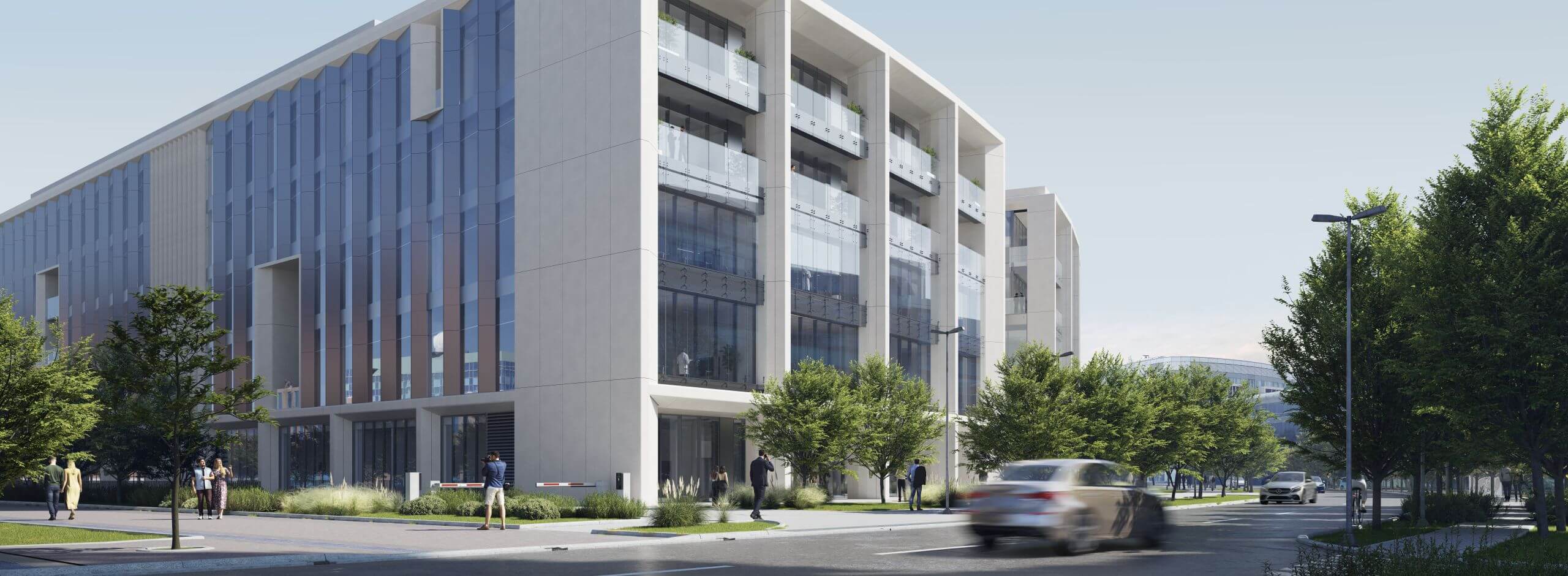
Frontiers Campus
Design of a world-class research, healthcare and office building on an undeveloped plot within the Infopark university campus.
read more
Hybrid project management in cleanroom investment
The survey was carried out using Leica laser scanners, the modeling tasks were carried out in Revit, the design was compared with the as-built condition in Cloudcompare, and the progress was documented with a 360-degree camera using OpenSpace.
read more
Continental site
As part of an investment of more than €30 million for Continental, one of the world’s leading automotive companies, we designed a complete site of 30 100 m2 in 5 phases over 5 years using BIM methodology.
read more