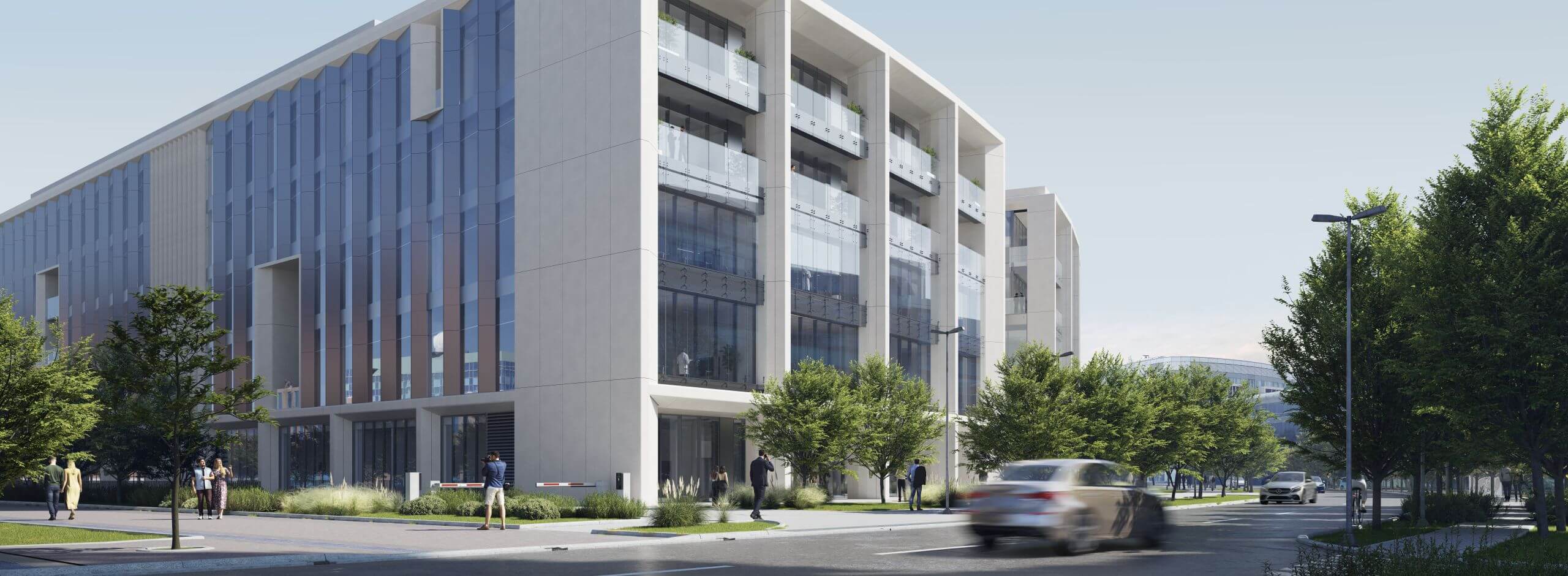
From spark,
to discovery
Frontiers Campus
Client: Molekuláris- Ujjlenyomat Kutató Központ Kft.
Size: 48 000 m2
Location: Budapest, Infopark
Completion: 2028
Architect: Csaba Livják
Services: Architectural design, BIM services, Concept design, General design
Sectors: Healthcare
The project
In 2024, we were commissioned to prepare the preliminary and then the final concept design for a new research, healthcare and office building. The goal of the project, developed under the name Frontiers Campus, was to create a unique research centre on an undeveloped plot within the Infopark university campus.
What makes the project special?

The client for the project was the Centre for Molecular Fingerprint Research, which, under the professional leadership of Hungarian Nobel Prize-winning physicist Dr Ferenc Krausz, is working on the validation of laser-based molecular fingerprint technology in cooperation with Ludwig Maximilian University of Munich and the Max Planck Institute of Quantum Optics.
The aim of the research is to develop a method capable of detecting cancer as well as cardiovascular diseases even before symptoms appear.
The project is part of the Élvonal Programme, which is built on three pillars: cutting-edge research, talent development, and the social application of scientific results. The new scientific centre, to be built between Eötvös Loránd University (ELTE) and the Budapest University of Technology and Economics (BME), will provide an outstanding environment for the researchers of the future while also bringing together research activities that are currently spread across several countries, connecting laser physics, molecular sciences, biobanking and artificial intelligence.
The commission was therefore about creating a building complex with an extraordinary vision, one whose significance extends well beyond itself.
At the Boundary of Science and Culture
The site is located in a distinctive university and urban setting: it is bordered on the east by the southern block of the ELTE Lágymányos Campus, and on the northwest by BME Building I.

The architectural character that has developed along Magyar Tudósok Körútja is notably diverse: brick architecture, the futuristic forms of Tüskecsarnok, the monochrome material use of newer developments, and the tower of MOL Campus all serve as strong points of reference.

Rather than responding to this heterogeneous context with a single gesture, the planned building connects consciously to its surroundings through both its massing and façade design. Its relationship to the building volumes facing the Danube is expressed in its block-like, monumental appearance and in the alternation of pilaster-articulated and curtain wall façade sections.
Adaptive Façade Design
The core architectural idea is that each side of the building responds differently to its surroundings and to internal use. Each façade has its own character: the exterior appearance not only fits into the context of neighbouring buildings, but also makes the building’s internal logic visible.
The fan-like opening main façade was given a more even articulation, softened by an arcade-like formation. By contrast, the side and courtyard façades respond to the larger, less articulated surfaces of the neighbouring buildings. The quasi-arcaded character of the side façade of BME Building I is echoed at podium level, while the lightweight, sawtooth motif of BME Building Q served as an important formal reference.
 Side façade of BME Building
 The arcaded character of the side façade of BME Building I, designed by Finta Studio, is echoed at the podium level of the planned building and continues along both the side and courtyard façades. Within this base zone, the denser glazing pattern helps distinguish the ground floor more clearly from the upper storeys.
  ELTE Lágymányos Campus, Southern Block, 38 (Wikimedia)
  The side façades of the neighbouring buildings are barely articulated, and the design responds to these large, continuous surface planes.
 Side façade of BME Building Q
 The lightweight enclosed balconies with their sawtooth-folded articulation on the side façade of BME Building Q served as an important reference.
 Hidden Engineering Complexity
One of the greatest challenges of the development was that the building had to accommodate a wide range of highly specialised technologies and functions, including biological, chemical and physical laboratories, a vibration-isolated clean room, a biobank, a clinic, and a visitor centre, all of which require substantial mechanical, electrical and technological infrastructure. The design task was not only to provide space for these functions, but also to organise the critical service zones and extremely complex network of pipelines and systems within a unified structural framework, without overburdening the building’s appearance.
According to the architectural concept, the façade follows the structure behind it. The fan-like opening main façade is given an even articulation, and in this section the structural system differs from the internal grid, a condition resolved by the arcade formation.

In the Frontiers Campus project, architectural quality and technical integration are inseparable. BuildEXT’s role was precisely to transform this dense and highly complex technical background into an architectural order that appears clean and coherent from the outside, while the façade structure subtly expresses the position and diversity of the internal functions.
Materials and Façade System
The solid surfaces of the building are clad with fibre-reinforced fine concrete façade panels, which give the building a homogeneous, contemporary character. The material provides a monolithic appearance while allowing for finely detailed column and pilaster formations, as well as wrapped corner solutions.

The façade system is complemented by various glazed and screening structures: structured curtain walls, climate façade sections with concealed shading, and a mechanical stage façade. These do not appear as independent visual elements, but rather organise the building’s functional and technical layers into a unified architectural whole.
Architectural Framework
The resulting architectural system responds at once to the environment of the Lágymányos campus and to the internal operation of the building. Form, façade and material use are therefore not self-serving gestures, but the consequence of a complex programme that brings together research, healthcare, educational and support functions within a single building complex.
Within this framework, the individual building wings take on different yet closely interconnected roles. Below, we present the functional structure and architectural logic of these units.

Building “B” – Centre for Molecular Fingerprint Research (CMF)
➔ Laser Research Centre – Research, Healthcare and Office Functions
The most complex element of the Frontiers Campus project was Building B, the more than 16,000-square-metre unit of the Centre for Molecular Fingerprint Research (CMF), combining research, healthcare and office functions. Here, BuildEXT’s task was not simply to design a laboratory building, but to integrate a highly technical environment supporting a complete and interrelated technological chain, from the reception and processing of blood samples through cryogenic storage to laser-based research.
The scale of the challenge is reflected in the fact that the centre had to be prepared from the outset to serve a biobank capable of storing 2 million samples, with the system designed for future expansion up to 20 million samples.
Building B contains a coordinated system of laboratories and support spaces with different technological requirements, including a specialised vibration-isolated optical clean room, mass spectrometry, molecular biology laboratories, support units related to cryogenic automated sample storage, such as sample handling and freezer areas, as well as server infrastructure for research data storage.

A major engineering challenge was the creation of the 750 m² laser laboratory complex, where the technology required a 4.5-metre clear height and overhead crane servicing, as well as the integration of the high-capacity biobank background infrastructure. Designed for a staff of nearly 100 people and 100–200 daily visitors, this part of the building serves a highly complex role. The design had to create a high-tech research environment, an efficient workplace, and the conditions for a visitor and healthcare centre at the same time.
➔ Healthcare Centre – Specialist Consultation and Diagnostic Unit
In designing the healthcare centre, BuildEXT’s task was to create a multifunctional research environment serving the scientific requirements of molecular fingerprint testing. The building section includes more than ten specialist consultation rooms, sampling laboratories, and complex imaging diagnostic units. The design focused on the logistics of biobank sample collection, the logical routing of study participants, and the precise separation of research support processes from clinical spaces.
In addition to general and specialist consultation rooms, the design also had to integrate high-tech functions such as CT, MRI, X-ray, mammography and ultrasound, together with the associated operator and reporting rooms. This infrastructure makes it possible to monitor participants’ health status, establish accurate diagnoses, and ensure lifetime traceability of the samples. The system of waiting areas, reception and back offices therefore forms a unified base that supports not only top-level diagnostics but also independent outpatient care.
The building also includes a conference hall and bar for nearly 140 people, a visitor centre, research apartments, and more than 1,000 square metres of office space for processing research activities.
BUILDING „A” – Élvonal Centre
➔ Multifunctional Office Building and Scientific Centre
The development of the Élvonal Centre represented a different but similarly complex architectural task. The 18,000-square-metre Building A wing had to accommodate 40–45 research groups, each typically with 10–15 members, so BuildEXT’s task was to create a flexible, user-friendly and sustainable research environment for the long term.
This part of the building contains chemical preparation, biological, optical and mechanical laboratories, each with specifically defined mechanical and technological infrastructure. The offices serving processing work were positioned along the façade, providing ample natural light and good views.
Meeting points, relaxation areas and phone booths were also placed along the circulation routes, meaning that this section offers not only workplaces but a genuine research ecosystem. A particularly distinctive feature of the programme is a three-group kindergarten for 75 children, created as an independent unit within the building complex, with its own entrance and separated courtyard connection, primarily intended for the children of researchers working here.
 Building “A”
 Labor (concept design, BuildEXT)
 Building “A”, atrium view (concept design, BuildEXT)
 Building “A”, office (concept design, BuildEXT)
 Building “A”, conference hall (concept design, BuildEXT)
 Building “A”, waiting room (concept design, BuildEXT)
 Building “A”, skybar (concept design, BuildEXT)
 Building “A”, accomodation (concept design, BuildEXT)
Underground Garage
➔ Logistics for Passenger and Service Traffic
One of the less visible yet crucial elements of the project was the design of the 11,452 m² garage and the logistics system. Here, BuildEXT’s task was not simply to meet parking demand, but to create a circulation system serving different types of use while safely separating passenger traffic from technological freight traffic. Accordingly, Frontiers Campus was given two separate road connections from Magyar Tudósok Körútja: one serving the shared underground garage, and the other dedicated specifically to economic and technological traffic reaching the building.

The design of the back-of-house logistics required exceptional complexity: in addition to supplying the laboratories and healthcare units, we had to solve the reception of -80°C blood samples arriving from external locations, as well as the segregated handling of hazardous waste.
The greatest challenge was the replenishment of the liquid nitrogen required for cryogenic storage: the 40-ton articulated truck arriving several times a week must refill the 50 m³ tank from above the closing slab of the underground garage, in the immediate vicinity of a vibration-sensitive building. The high-load internal road created between the building sections ensures that this critical service traffic can operate completely separately from daily use and without disruption.
Multifunctional Building Complex
One of the biggest design challenges of the project was the coordinated placement of functions requiring critical infrastructure. The integration of specialised spaces, extensive mechanical servicing, and several hundred kilometres of pipeline systems had to be resolved in a way that would maintain a clean and unified architectural character.
The two main functional units of the building will be constructed at the same time, but brought into use in different phases. The below-grade areas and the functions of Building B will be completed first, while Building A will be realised in the second phase as a continuation of the unified basement system.
“We are building Frontiers Campus so that it will rank among the best – a place where the world’s best researchers will gladly come, and where the best Hungarian researchers will gladly return.”- Ferenc Krausz, at the cornerstone-laying ceremony, 31 March 2026
Because of its scale and technical complexity, the Frontiers Campus project represented a particularly significant design task. In this work, BuildEXT provided an architectural response that brings research, healthcare and operational requirements together within a single clear system, creating a stable foundation for the long-term functioning of the building complex.
Team
BuildEXT
Chief Architect: Csaba Livják
Lead Architect: Balázs Csapó
Architectural Project Lead: Botond Csáji
Architects: Ádám Bujtás, Sándor Nagy
Architectural Team Members: Benedek Szánthó, András Szily, Márk Kőrösi
Mechanical Engineer: András Manherz
Mechanical Engineering Team Members: Zsolt Czirok, Péter Tóth, Barnabás Horváth, Tamás Borsay, Balázs Fodor, Ádám Kalinszki, Máté Ecker
Electrical Engineer: Tamás Domonics
Electrical Engineering Team Members: Ottó Nemesvári, Csaba Rasztik, Kornél Szinyéri, Máté Zahora
External disciplines
Structural Engineer: Péter Markovits
Fire Safety Engineer: Zsolt Fenyvesi
Fire Suppression System Engineer: Balázs Szakos
Building Structures: Gábor Schreiber
Medical Technology: Szilveszter Csordás
Environmental Protection: Levente Földi
Road Design: Krisztina Grosz
Utilities Design: Péter Kovács
Landscape Architecture: Zsombor Tatai
Acoustics: Attila Balázs Nagy
Kitchen Technology: András Gauland
Explosion Protection: László Lórántfy
Lifts: Zoltán Kurucz
Accessibility: Betti Boldis
Photos & CGI
BuildEXT

Related projects

Continental site
As part of an investment of more than €30 million for Continental, one of the world’s leading automotive companies, we designed a complete site of 30 100 m2 in 5 phases over 5 years using BIM methodology.
read more
Electronics component manufacturing plant and office development
Swiss group expands manufacturing capacity in Budapest with a newly built electronics component manufacturing plant in two phases.
read more
Academia
Interior redesign of the representative Danube-side office building of the Academia. The project involved the design of 1800 m2 of community, commercial and office space.
read more